 bahasa indonesia
Strengthening Primary Healthcare Quality: MHPE Research Group Trains Community Health Center Doctors from the Solo Region as Clinical Preceptors
 30/8/2026


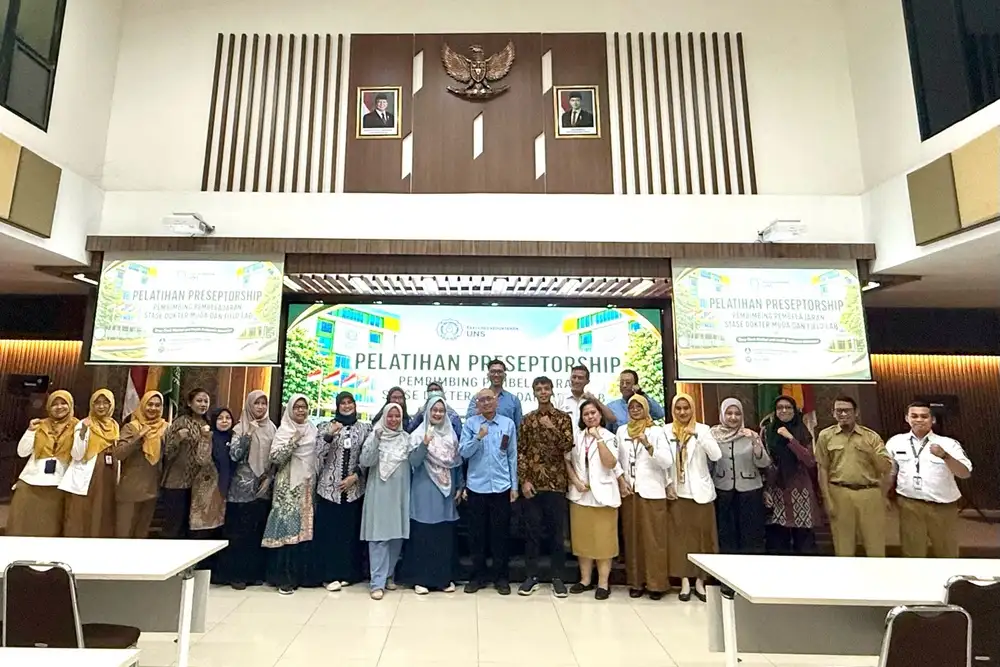
Within the primary healthcare system, Community Health Center (Puskesmas) physicians serve not only as clinicians but also as clinical mentors (preceptors) for health profession students undergoing field training. The quality of this mentorship influences both the standard of clinical education and patient safety. Consequently, strengthening the clinical pedagogical competencies of Puskesmas physicians is a strategic necessity, particularly given the ongoing primary care transformation that positions these centers as the foundation of the national health system.
On Tuesday (July 14, 2026), the Medical and Health Profession Education (RG MHPE) Research Group from the Faculty of Medicine at Universitas Sebelas Maret (FK UNS), in collaboration with a student team from the “KKN Rekognisi” (Recognized Student Community Service) program, conducted a community service initiative titled "Strengthening Puskesmas Physicians' Competence as Clinical Preceptors." The event took place at the Medical Education Building Auditorium of FK UNS, Surakarta. Part of the Research Group Community Service Grant (PKM HGR-UNS) program, this initiative aimed to enhance healthcare professionals' skills in clinical supervision, workplace-based assessment, and the provision of reflective and constructive feedback to students.
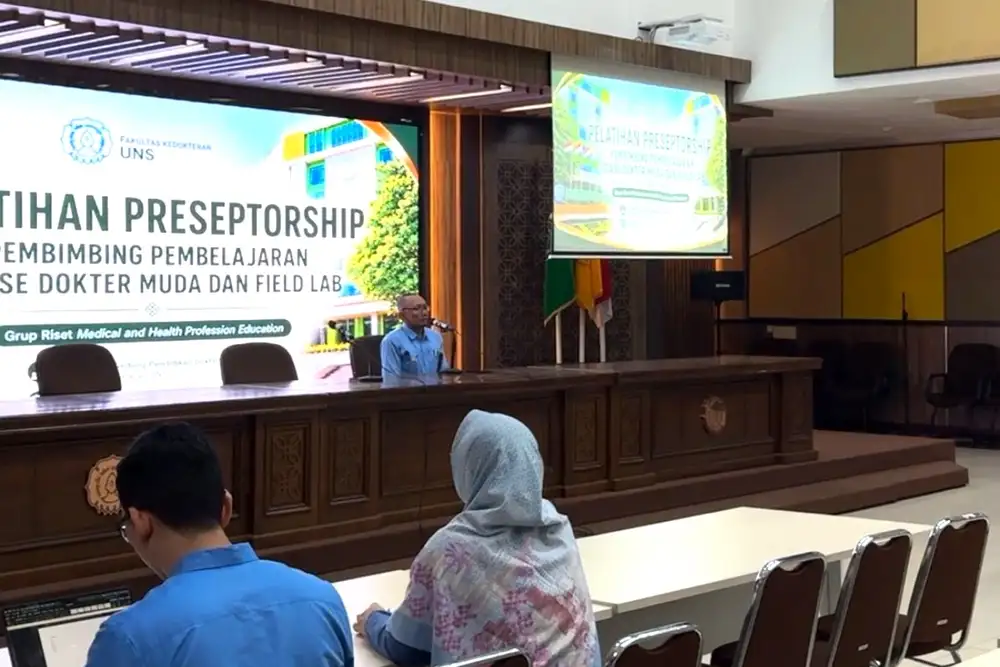
The event opened with remarks from Dr. Bulan Kakanita Hermasari, MMedEd, FFRI, the Head of Community Service, followed by an address and the official opening by Dr. Annang Giri Moelyo, Sp.A (K), M.Kes., the Vice Dean for Non-Academic Affairs at the Faculty of Medicine, Universitas Sebelas Maret. Prior to the presentation of the material, participants completed a pre-test to assess their baseline knowledge.
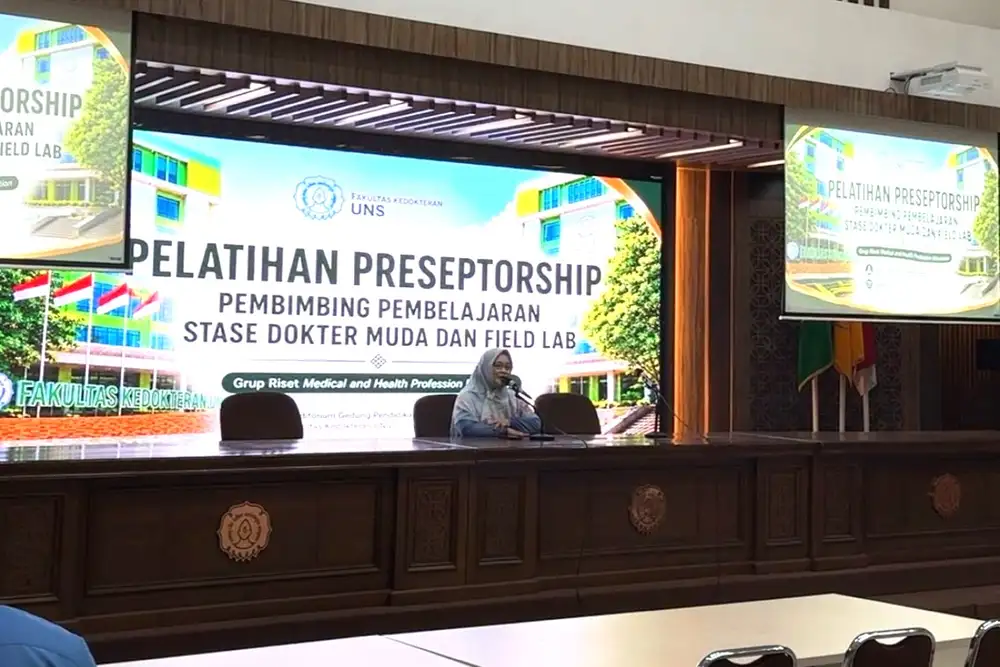
The first session, covering interprofessional education and the role of the clinical preceptor, was delivered by Dr. Amandha Boy Timor Randita, MMedEd, Sp.K.F.R. In the presentation, the speaker emphasized that the preceptor role requires specific skills distinct from mere clinical competence—encompassing educational guidance, objective competency assessment, and the design of learning experiences for students within primary care settings. The speaker also introduced simple applications of workplace-based assessments, such as the Mini-CEX and case-based discussions, and highlighted the importance of integrating patient safety principles into daily clinical learning processes.
The second session, focusing on feedback techniques, was presented by Dr. Veronika Ika Budiastuti, dr., M.Pd. She explained that effective feedback should be reflective and constructive, delivered in a structured manner through a two-way dialogue between the preceptor and the student, and aimed at identifying strengths, areas for improvement, and concrete follow-up plans. This approach has been shown to contribute to enhancing the quality of clinical learning and improving students' reflective capabilities.
 |
 |
 |
(Swipe for the next photos)
The activity also involved the "KKN Rekognisi" (Recognition-based Community Service) program team, comprising five undergraduate medical students from the Faculty of Medicine, Universitas Sebelas Maret (FK UNS), who served as facilitators and organizing committee members. The five students were Aliya Salsabila Aflah, Raihan Abdi Arrasyid, Rajiv Abdallah Perwiranegara, Ath Thoriq Luthfi Hanif, and Deliana Wahidji. Through this involvement, the students supported the execution of the activity while simultaneously developing their communication and professionalism competencies as aspiring doctors under the P2M Recognition-based Community Service scheme.
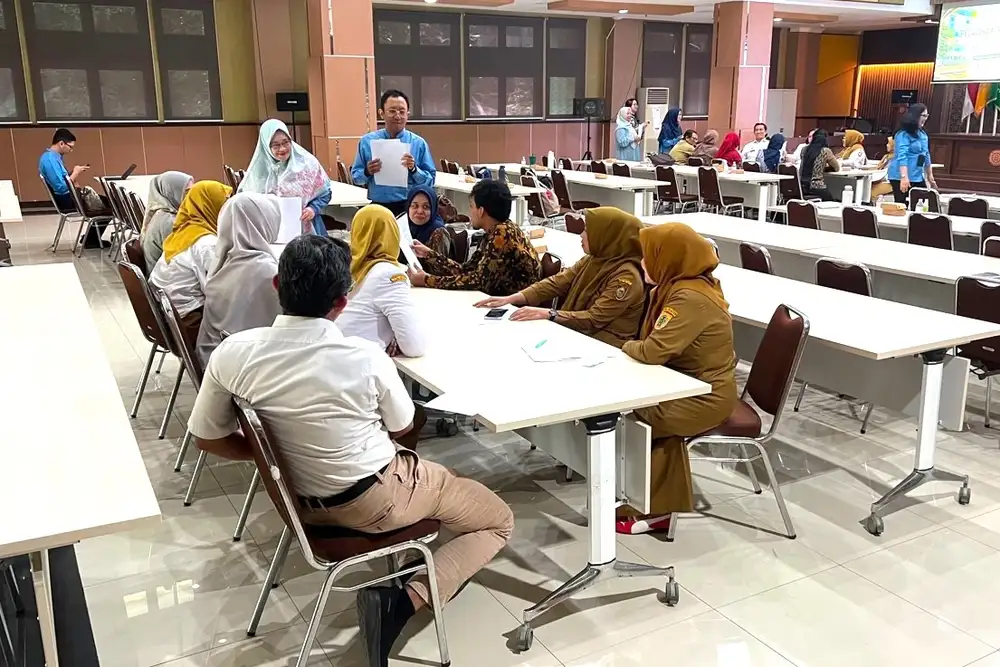
The event was attended by approximately 28 healthcare professionals representing various Community Health Centers (Puskesmas) in the Surakarta, Klaten, Boyolali, and Karanganyar regions. The participants represented a diverse range of professions—including physicians (among them several Heads of Community Health Centers), nurses, midwives, and pharmacists—reflecting a spirit of interprofessional collaboration in clinical supervision. The training program was designed to be participatory, featuring interactive mini-lectures, case discussions based on actual service scenarios in Community Health Centers, and simulations and practice sessions on providing feedback. Participants were also introduced to workplace-based assessment tools—methods for evaluating student competence during actual practice—such as the Mini-CEX (Mini Clinical Evaluation Exercise), which involves brief observations of student-patient interactions, and discussions based on real-life cases. Participants showed great enthusiasm throughout the sessions, actively engaging in discussions and posing questions to the facilitators. A post-test conducted at the end of the training to measure knowledge gains yielded positive results, with an average material mastery rate of 95.8%.
In his closing remarks, the Head of the Community Service Program expressed his gratitude for the active participation of all attendees. He expressed hope that the training would serve as a foundation for strengthening the quality of primary care-based clinical learning, while simultaneously enhancing the quality of care and synergy among healthcare professionals in delivering the best possible services to the community.
This community service activity aligns with efforts to achieve the Sustainable Development Goals (SDGs), specifically SDG 3 (Good Health and Well-being) by strengthening the quality of primary healthcare services; SDG 4 (Quality Education) by enhancing the clinical pedagogical capacity of preceptors; and SDG 17 (Partnerships for the Goals) through partnerships between higher education institutions and healthcare facilities.
Public Relations of FK UNS